
Zum Inhalt springen
DE
Julian Hoeke on an e-foil off Mallorca in a tailored suit — Hoeke Yachting's unmistakable style for yacht buyers

Buy · Season 2026

Buying a yacht with German-speaking guidance — from selection to handover

Buy · Season 2026

Buy a yacht on Mallorca

Personal guidance through your yacht purchase — from the profile conversation to the handover. New, used or custom-build. With local knowledge and an international standard.

Buying a yacht is not like buying a car — even if the comparison comes up often. The yacht sits in a foreign country, you see it twice at most before the purchase, the contract touches at least three legal systems, and what follows the handover is more work than the purchase itself. That is precisely why advice with me looks different from the classic platforms.

The right yacht class can shift by two orders of magnitude — depending on how you actually intend to use her.

Julian Hoeke

Four questions before we talk about yachts

Before I propose your first yacht, we settle four points: How will you actually use the yacht? (day trips vs. week-long trips vs. long-range cruising), Who runs her? (you yourself, a permanent skipper, a rotating crew), Which bay or cruising ground is your focus? (the Bay of Palma, the Tramuntana, the Menorca–Ibiza axis, a Mediterranean crossing), and What time horizon are you planning for? (three years, ten years, a yacht for life). The answers can shift the right yacht class by two orders of magnitude — and save you six- or seven-figure sums, or a yacht you sell again after two seasons. For a fuller orientation — market, tax, berth — see my guide to buying a yacht on Mallorca. Once you have settled on the west of the island, the hyper-local variant is at buy a yacht in Andratx. Structural questions (tax, financing, running costs) I cover in seven deep dives in the guide — in particular Matriculación and yacht running costs belong in the pre-purchase phase.

New, used or custom — an honest assessment

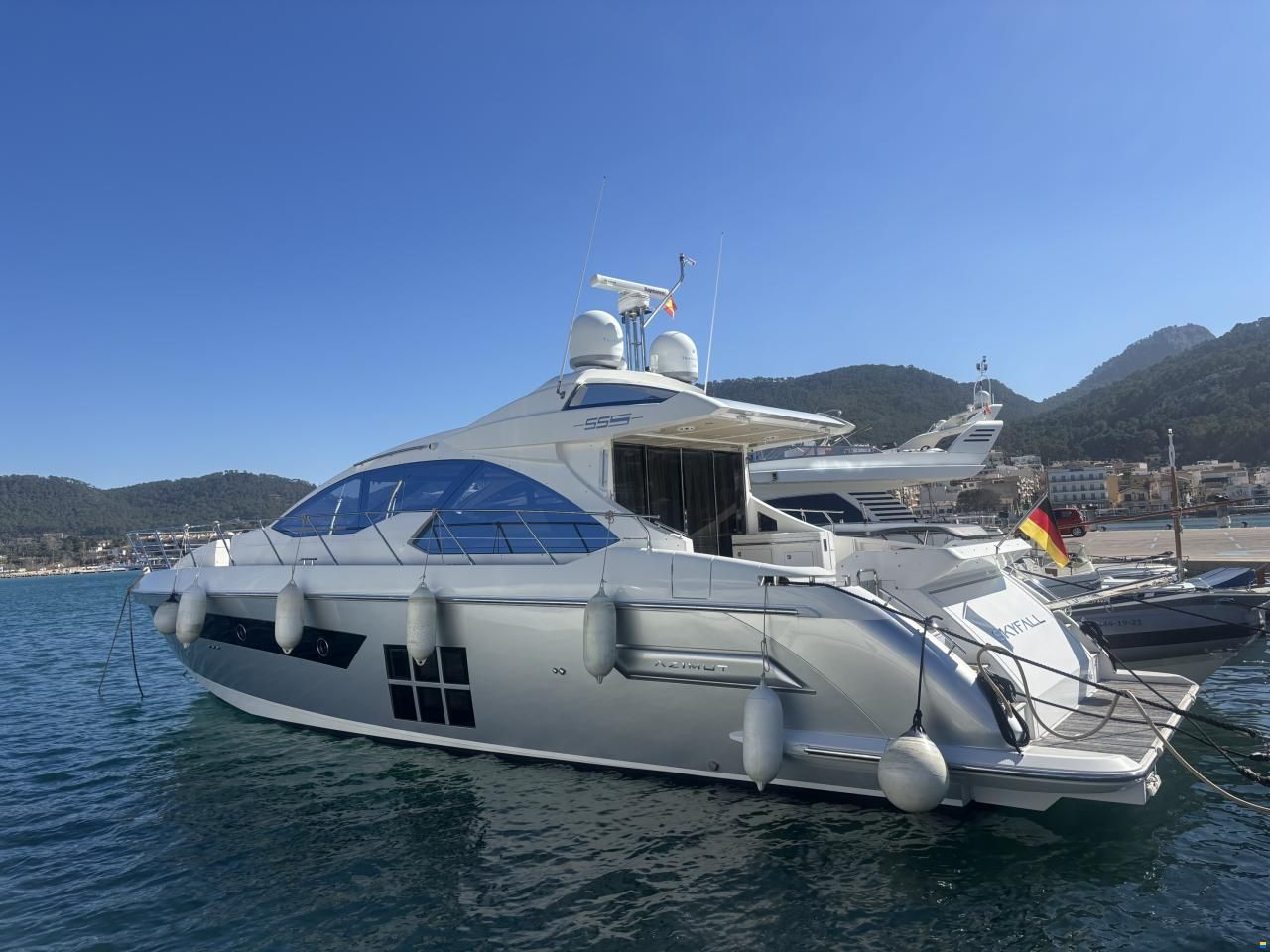
With yachts under 60 ft, I usually recommend well-kept used yachts from a second owner. Depreciation in the first two years is steepest here; a two- to four-year-old Sunseeker, Princess or Azimut with a documented care history costs 25–35 percent less than the list price and is often more technically mature than the current model.

For yachts between 70 and 100 ft the question gets more complex. A custom refit is often the more elegant solution here — a three- to five-year-old yacht with a good survey, followed by a three-month refit (interior, electronics, drivetrain if needed), delivers a near-new yacht at 60–70 percent of the new price. With superyachts from 30 m the custom build from the yard becomes interesting, because specification is decisive; here I work with yards in IT, NL, DE and TR, depending on profile and budget.

VAT, flag, and the Spanish special case

Three topics that often get short shrift in DACH-based advice, because the yachts are not in the water there: VAT status (EU-taxed, "Temporary Admission", charter licence), flag (Spain, Malta, BVI, UK — each with its own implications for charter use and running costs) and Matriculación (the Spanish special rule for charter-used yachts that permits berthing in Spain). These points belong in the first draft contract, not in a renegotiation. I work with specialised lawyers in Palma who clarify each of these points up front — and that before you reserve a yacht.

What awaits you after the purchase

A yacht is not finished when the purchase contract is signed. Arranging a berth (in the sought-after marinas the wait can be twelve months), finding crew, calibrating insurance, planning wintering, maintenance through the first seasons. All of that I offer as ongoing yacht management after the handover, if you wish — either in full or selectively. Most of my owners chose me for exactly that reason: because the purchase is only the beginning.

If you would like to get specific — whether with a clear profile or with first questions — write to me. A personal reply within 24 hours, with no sales pressure.

— Julian Hoeke
Standard and ambition

  • MYBA-conform contracts

    Internationally recognised purchase-contract standard, clear defect terms.

  • DACH buyer pool

    Active enquiries from DE, AT, CH, UK and NL — curated, not scattered.

  • Survey & VAT handling

    Independent surveyors, VAT clarity and Matriculación from a single source.

  • Berth placement

    Direct access to Puerto Portals, Port Adriano, Club de Mar.

Process

Five steps to your own yacht

  1. Briefing & profile

    A personal conversation: home port, crew setup, season profile, budget, preferred shipyard. I give you honest feedback on what is realistic.

  2. Curated proposals

    Three to five specific yachts — new, used or both. Each option with a pros-and-cons list, a technical assessment, and a market-price comparison.

  3. Viewing & survey

    We view on site together, an independent surveyor carries out the technical inspection, and we run a sea trial if needed. I attend every appointment in person.

  4. Negotiation & contract

    MYBA-conform purchase contract, negotiation, allowance for any defects from the survey, and VAT clarity (EU status, export, charter licence).

  5. Handover & berth

    Transfer of ownership, insurance, flag, and a berth reservation in your preferred marina. If you wish: ongoing yacht management after the handover.

Frequently asked

Buying a yacht on Mallorca — what matters

What does a yacht cost on Mallorca on average?

A very wide range. A used daycruiser under 40 ft starts at around €80,000. Motor yachts of 50–60 ft in good condition sit between €350,000 and €1.2M. Yachts of 70–90 ft are typically €1.5–6M used, €4–10M new. Superyachts from 30 m: €8M and up. More important than the headline range is your specific market — I give you an honest read on your profile before I propose the first yacht.

Should I buy new or used?

Rule of thumb: with yachts under 60 ft, depreciation is steepest in the first two years — if you keep the yacht for at least five years, a good used one is usually the cheaper route. With larger yachts from 70 ft up it depends more on specification and shipyard; sometimes a three-year-old yacht with a perfect refit beats a new one with standard fit-out. I help you judge that in your specific case.

How does VAT on yachts work in the EU?

A central question. EU-taxed yachts carry a documented VAT status (e.g. "VAT paid"); without proof, additional tax can fall due when moving into other EU countries. Non-EU-taxed yachts enjoy the "Temporary Admission" regime under certain conditions (max. 18 months in EU waters). For charter-used yachts there are Spanish special rules (Matriculación). Getting this right is part of the contract negotiation — I work with specialised lawyers.

What does it cost to keep a yacht each year?

A market rule of thumb: 8–12% of the purchase price per year for berth, insurance, maintenance, crew share and wintering. For an 80 ft yacht worth €2.5M that is a realistic €200,000–300,000 per year (before fuel). With charter use, part of the cost can be recovered — we work through a clear cashflow before every purchase.

How long does a yacht purchase take, from selection to handover?

For a used yacht, typically eight to twelve weeks — viewing, survey, negotiation, contract, VAT and flag logistics, berth. For a new build from the yard with custom fit-out, several months up to two years. Special situations (a forced sale, an in-stock yacht) can close in four weeks. I give you a realistic time estimate before every yacht.

Verifizierte Google-Bewertungen

5 / 5 aus 11 Google-Bewertungen

Originale Bewertungen auf Google lesen →

Send your yacht-purchase briefing

Describe your profile briefly — size, home port, budget, time horizon. Three specific proposals within 24 hours.

By submitting you consent to the processing of your data in accordance with our privacy policy.

Prefer to write directly? WhatsApp Julian · +34 628 22 15 00