
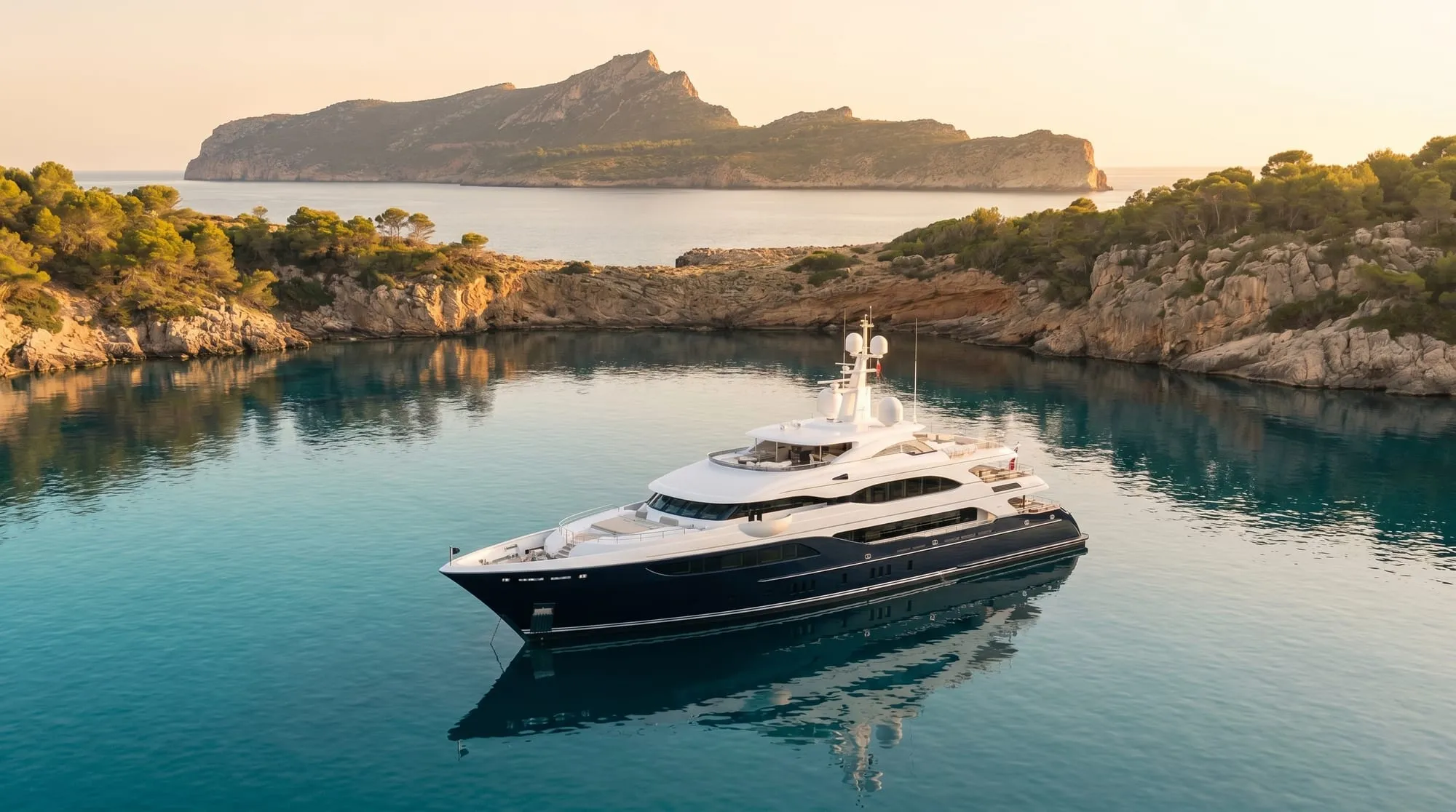
Three routes from Puerto Portals I run every year — south, west, Tramuntana. With anchorages, weather windows, and one story per route.
Anyone casting off from Puerto Portals has three very different Mallorcas ahead of them. To the south, shallow bays and salt lagoons. To the west, steep coast, Dragonera, and a lonely harbour. To the north, the Tramuntana mountains, falling all the way to the water. Which direction suits a given day is decided less by the destination than by the wind — and by which bay genuinely offers shelter come evening. Three routes I’ve run regularly for years, with their quirks and one story each.
Route 1: South — Cala d’Or, Porto Petro, Cabrera on the horizon
When there’s a Mistral or a strong Tramuntana wind from the north, the south coast is the right call. Weather window: wind from the north or north-east, sea under half a metre, classically between May and June or in September. With sun above 30°C the shallow bays fill from midday onward.
Cast off around 9:30 in Puerto Portals, course south-south-east along the coast. First anchor around 11:30 in Cala Pi, a narrow gorge bay with white sand and crystal-clear water over a sandy bottom. The anchor holds reliably here. Three to four hours of swimming, brunch on board, then on towards Cala d’Or or straight to Porto Petro.
My tip for an overnight: Porto Petro is the quieter, more atmospheric harbour — an old fishing village that wasn’t over-renovated. Berths on request are tight in season; in the low season (May, September) usually possible. The restaurants on the harbour are solid, nothing Michelin-level, but honest. Anyone wanting more buzz heads into Cala d’Or — bigger marina, more choice, less charm.
For the ambitious: with settled weather and an early departure, Cabrera is doable — a protected island group south of the main island, with a berth fee that must be booked in advance, but in return a stillness you can barely find on Mallorca itself any more. Anchoring isn’t allowed; only the designated buoys. The permit via the Reserva Marina should be applied for two to three weeks ahead.
A personal story: three years ago, in September after a charter, I went to Cabrera on a whim, alone, on a 13 m sailing yacht. Three days of no messages, no marina loudspeakers, the only other person the watchman at the lighthouse. I remember few days in ten years as precisely as that one.
Route 2: West — Andratx, Sa Dragonera, Sant Elm
With settled western weather and wind from the south or south-west, the west coast is the supreme discipline. Weather window: calm sea, wind under 15 knots from the south, ideally mid-June or mid-September. With a Tramuntana from the north, the stretch between Andratx and Dragonera turns unpleasant.
Cast off around 8:30 — this route only pays off if you start early and use the daylight for the return. First leg to Puerto Andratx: just under an hour, one of Mallorca’s prettiest small harbours with a fjord-like entrance and a row of good restaurants right on the water. If you like, anchor off Cala Llamp first, or run straight into the harbour.
From Andratx onward to Sa Dragonera, the island in the nature reserve off the western tip. Anchoring on the lee side (east side) is possible, but inside the nature park, mooring buoys are compulsory and tying off at the cliffs is forbidden. The buoys fill quickly in summer; anyone wanting to lie there is too late by 10:30. Alternatively: carry on past the protected zone and anchor off Sant Elm, an unassuming village with one of the better beach restaurants on the west coast — Es Molí d’En Galeta, if open, has been my lunch stop for years.
Return in the late afternoon: with southerly visibility the wind often drops, the stretch back to Portals takes three to three and a half hours, and the light on the west coast between 18:00 and 19:30 is the real reason to run this route. Anyone wanting to spend a night out: Andratx is the more honest choice than Sant Elm — more options, better crew provisioning.
A personal story: with a family from Munich, second charter week, the father alone experienced on board, the mother and three children never before on a yacht. We went to Sant Elm in the morning, back in the afternoon, three hours of anchoring, swimming, and a lunch the children fetched themselves from the beach restaurant in between. At the end of the week the mother told me that had been the day the children understood what a yachting holiday actually is. It wasn’t a luxurious day — it was a simple day. That’s usually the secret.
Route 3: Tramuntana — Sóller, Cala Tuent
The Tramuntana is Mallorca’s most spectacular coast — and the most uncompromising. Weather window: calm to light southerly, swell under half a metre, ideally between mid-May and mid-June or early October. With a Tramuntana wind from the north this route is not advisable — the cliffs throw the wind into unpredictable gusts, and sheltered bays are scarce.
Cast off early, 8:00, course north-east. Three hours to Sóller, past Bañalbufar, Estellencs, La Foradada (a cliff with a natural rock arch, photogenic). Sóller itself is the harbour of the Tramuntana — sheltered, managed, with the old harbour village, the historic tram to Sóller town, and a row of good restaurants. A high-season berth is likely tight; book ahead via the marina 7–10 days in advance.
Anyone not wanting to run the distance back and looking for a day destination instead: Cala Tuent north-east of Sóller, a crescent bay with coarse gravel and deeper water. Anchoring at 10–14 m over sand is possible; a westerly wind can turn unpleasant here. A beach restaurant (seasonal), no development, clear views of Puig Major behind. Four hours’ stay, then back towards Sóller or directly back to Portals — the latter means a late homeward run in the dark, which is not to be underestimated lightly on the Tramuntana coast.
This is the most demanding of the three. It only works in genuinely good weather and with an experienced skipper on board. For charter with a mixed crew I recommend running it as a two-day trip: Sóller overnight, an easy return on day two.
A personal story: a 60-foot sportfisher in May. We arrived at Cala Tuent around midday, the only anchor in the bay, the water so still that the onboard camera showed the anchor sharp underwater. The crew — four old friends who have sailed together since the late 1980s — sat for two hours in silence with coffee and croissants on the sun deck. Nobody took photos. It’s the kind of day that justifies a charter.
Before every route — a short reality check
Four points I discuss with every owner and every charter guest before any Mallorca route:
-
Weather, not wish. The loveliest planned route helps nothing if the weather makes it uncomfortable. On short legs I happily decide only the evening before.
-
Harbour availability, not harbour romance. Sant Elm and Cala d’Or are charming but tight in high season. Anyone wanting a guaranteed quiet night plans Andratx or Sóller with a reservation.
-
Crew constellation. With children or an inexperienced crew the first two routes beat the Tramuntana. With experienced hands and settled weather, Sóller is the highlight of the summer.
-
Honest return time. Three hours of planned return means four hours with a buffer. Anyone who has to be in the marina by 22:00 does not leave at 19:00.
If you’re planning a concrete route — either as a charter guest or as the owner of a yacht with its home port in Portals — write to me. I read the weather models, I know the bays, and usually there is one day in the next two weeks that’s right for exactly your dream route. More on how I work on my profile page or directly via the charter overview.
A good route doesn't start with the destination but with the wind — and with an honest read of which harbour will still be open come evening.