
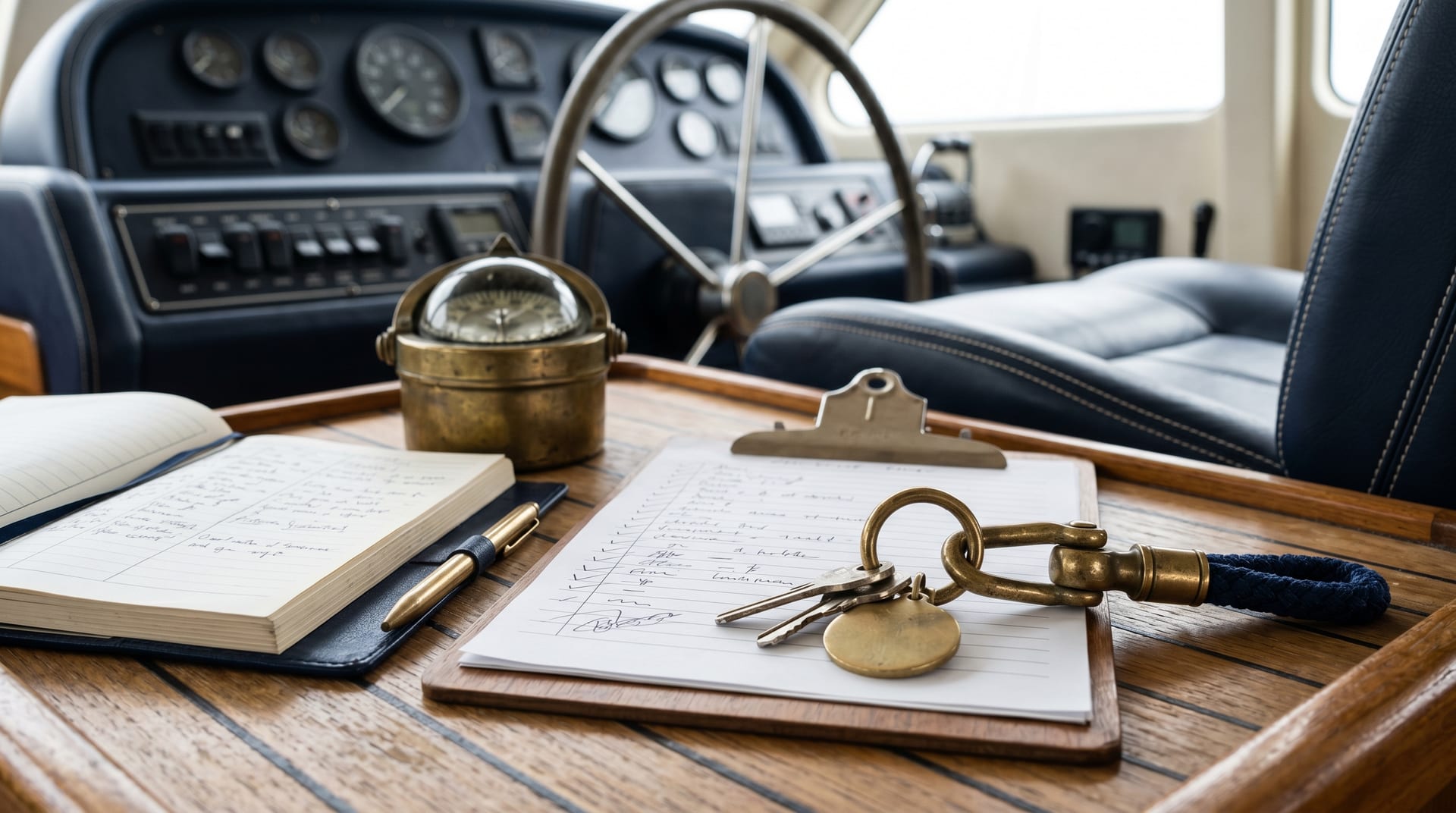
Guide · Yacht handover
The handover checklist — what must be inspected before keys change hands
Guides · Yacht Handover
Yacht Handover Checklist
What happens on handover day. What you must complete in the first 30, 60 and 90 days. Where UK buyers typically stumble. Drawn from supervised handovers on Mallorca.
The yacht handover is the most consistently underestimated moment of the entire transaction. Buyers spend months on the yacht model, the tax structure and the financing — and on handover day itself it all comes down to a four-hour walk-through with an inventory check. It looks like a formality, but it isn't: in those four hours it is decided whether you take on a complete yacht or a half-empty vessel with missing tools, patchy documents and a disgruntled crew.
This page is the checklist I have kept in spreadsheet form for my buyers for years — set out in full here and divided into four phases: handover day itself, days 1-30, days 31-60 and days 61-90. It does not replace personal supervision (that is my job), but it gives you and your broker the framework around which to structure the handover.
A yacht handover is not a formality. It is the only moment in which the whole transaction is still reversible — and the first day of the next ten years.
Handover day — hour by hour
A typical handover of a 60-70 ft motor yacht takes 4-6 hours, organised into five phases.
Phase 1 — welcome and document check (30 minutes). Buyer, seller, both brokers, skipper and, where relevant, notary meet on board. The draft handover protocol is reviewed. All original yacht documents are verified: registration papers, CE conformity certificate, ship's record book, insurance policy, the latest survey reports, yard warranties. For a Spanish flag, additionally: Patente de Navegación, matriculación certificate.
Phase 2 — technical walk-through (1.5-2 hours). A systematic walk-through, bow to stern. Engine room, generator, watermaker, air conditioning, electronics bay, navigation station, tender davits, watersports stowage. Every item ticked off against the inventory list. Any anomaly (a missing item, a defect) is documented in writing on the spot, with a photo.
Phase 3 — inventory reconciliation (1-1.5 hours). A detailed reconciliation of the MYBA inventory list — typically 150-250 items on a 65 ft yacht. Logbook, charts, tool sets, watersports equipment, tender, upholstery covers, crockery, linen, software licences for navigation and entertainment. Differences are either rectified on the spot by the seller or agreed as a lump-sum deduction from the balance of the purchase price.
Phase 4 — demonstration run (1 hour, optional). A short outing with the seller's skipper to demonstrate all systems under load — bow and stern thrusters, anchor mechanism, autopilot, stabiliser (if fitted), generator at full load. Particularly important on yachts with complex hybrid propulsion or newer electric systems.
Phase 5 — signing and handover of keys (30 minutes). Signature of the handover protocol by buyer and seller. Confirmation of receipt of the final payment into the escrow account. Handover of all keys, codes and software logins. The first insurance confirmation is lodged. A photo together on the pontoon is optional, but my clients value it.
The first 30 days — mandatory list
Seven items that must be completed in the first 30 days — otherwise they become stumbling blocks for the next 90.
| Day | Activity | Responsible |
|---|---|---|
| 1-3 | Convert insurance into an active policy | Buyer + insurer |
| 3-7 | Formalise berth contract with the marina | Buyer + marina |
| 7-14 | Crew contracts if taking crew on | Buyer + crew + employment lawyer |
| 10-15 | Activate yacht management contract | Buyer + management provider |
| 14-21 | Fuel account at the marina fuel dock | Buyer |
| 20-30 | Notarised copies of all yacht documents | Buyer + notary |
| 25-30 | First real run with a local skipper | Buyer + skipper |
The order is not rigid — many items run in parallel. But all seven must be ticked off before day 30.
The 60 and 90 day phase
Days 31-60 — structural processing. This phase completes the slow administrative processes that could not be finished by handover. That includes the flag transfer, with registration in the relevant ship register (UK/DACH: typically 4-8 weeks; Spanish: 6-12 weeks depending on the Lista variant). For a Spanish flag, the matriculación payment falls due in this phase — the gestor files Modelo 565 with Hacienda, and the amount is set against an on-board valuation. Also: a first routine inspection at the local yard (often sensible 6 weeks after handover, to verify the survey findings), and a first tank microbial inspection where there has been a long lay-up.
Days 61-90 — adjustment and validation. The yacht is now fully in service. Crew operations are routine, maintenance cycles are running, the first charter booking (if a charter structure) has taken place. I use this phase for the performance review: fuel consumption against the manufacturer's figures, power draw against generator hours, air conditioning and watermaker against routine values. Deviations above 15% point to a maintenance need. In addition: tax-return initialisation under a Spanish flag — the accountant receives the first bookkeeping data from day 60 and consolidates it into the quarterly return.
What is no longer the handover phase after 90 days: from day 91 the yacht is finally "yours". Survey findings not addressed in the first 90 days fall under normal maintenance responsibility. Crew contracts not formalised in the first 60 days count as tacitly assumed. The transitional insurance expires and the full hull policy takes effect. From an owner's perspective: day 91 is the day the owner's life begins.
Three months after handover is when it is decided whether the yacht becomes a pleasure or a chore. With structured supervision, it becomes a pleasure.
Continue reading
- Buying a yacht on Mallorca — guide 2026 — the full process from first briefing to handover.
- Spanish Yacht Tax — Matriculación — the tax position that falls due in the 60-day phase.
- Yacht Financing Mallorca — financing structures that must be in place before handover.
- Yacht Running Costs — the annual cost calculation that starts to run from day 31.
— Julian Hoeke
Frequently asked
Yacht handover — seven specific answers
What actually happens on yacht handover day?
What must I do in the first 30 days after handover?
What comes on days 31-60?
What needs to be completed on days 61-90?
When do I officially take ownership — at contract signing or at handover?
What are the most common handover problems for UK buyers on Mallorca?
Is there an official handover standard, or is everything bespoke?
Supervision for your yacht handover?
A specific completion date, yacht class, planned location — a short note describes your situation. Personal reply within 24 hours.