
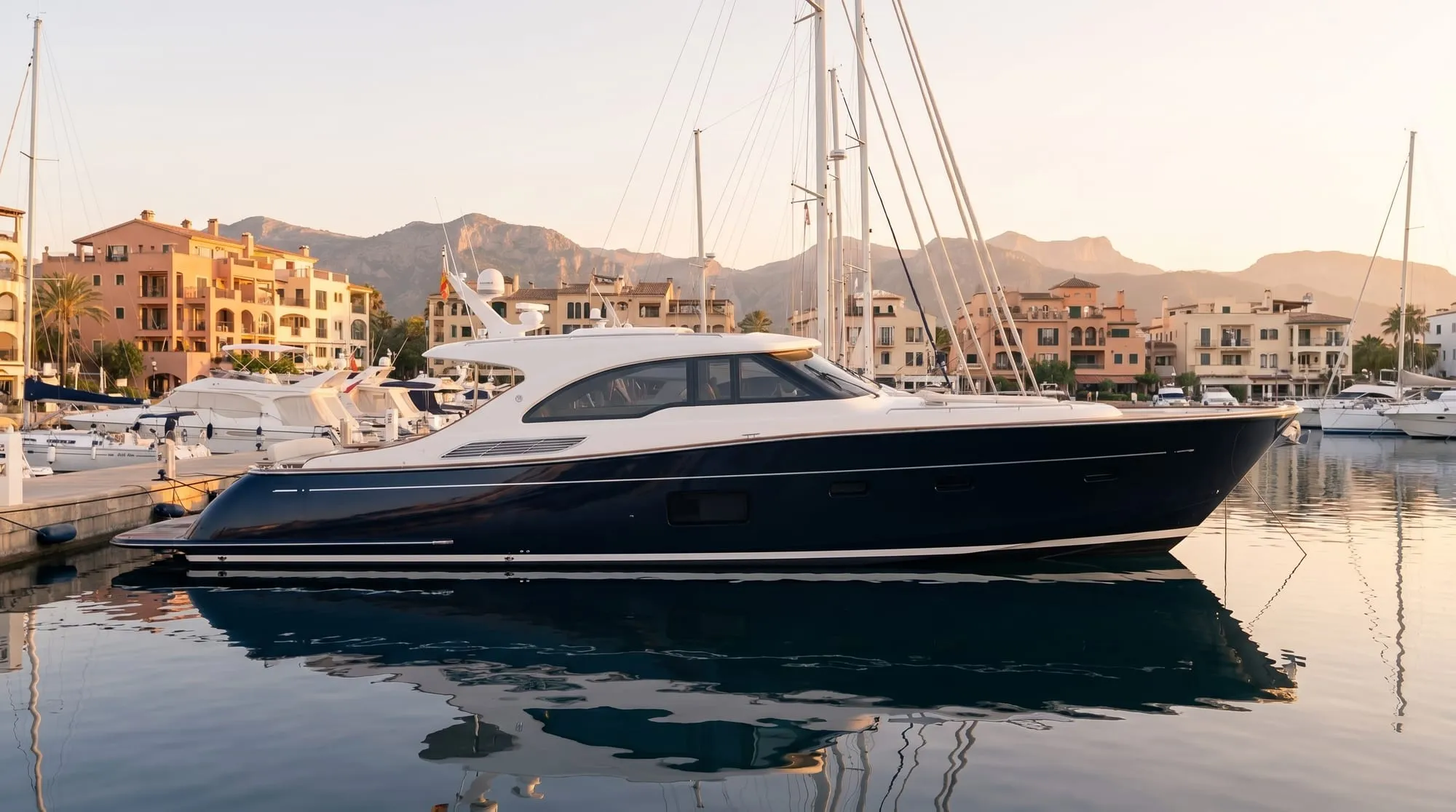
Three market shifts shape buying a yacht on Mallorca in 2026: delivery times, the Spanish Matriculación tax, and shipyard capacity. With concrete Q1 examples.
What sets Mallorca’s yacht market in 2026 apart from 2022 or 2024 is less dramatic than the headlines suggest — and far more relevant to your next concrete purchase decision. The market is neither “hot” nor “collapsed”. It is more attentive: buyers research longer, shipyards are taking sensible appointments again, and three structural factors determine what a yacht really costs in 2026 — and what running costs it produces afterwards.
What has changed since 2024
The biggest change versus 2022/2023 is mundane: delivery times for new yachts are back within a normal range. Anyone who ordered a Sunseeker or Princess in 2022 waited 18–24 months. In early 2026 we are back to 8–12 months for most yards, in some cases under six. That has two consequences that directly affect your buying decision.
First: the secondary market has lost its pressure. During the supply bottlenecks, used yachts of the recent build years (2019–2022) regularly sold above their original list price — the owner saved 18 months of waiting. That premium has vanished. A 2021 Sunseeker Manhattan that could still fetch €2.4m in 2023 now sits realistically at €2.0m to €2.2m. Anyone entering in 2025 or 2026 can count on a realistic discount window of 12 to 18 percent below listing prices — provided they are willing to negotiate seriously and to walk on to the second-best yacht if the owner won’t move.
Second: the yards are accepting custom orders again. In 2023, custom slots at the top yards were practically unbookable; every slot was built on spec, finished before the buyer brief. In 2026 the picture flips. Anyone willing to pay the premium (typically 8–15% over standard spec) gets genuine configuration freedom again — layout, propulsion, interior fit-out. On a six- to eight-million-euro yacht, that matters.
The Spanish Matriculación tax: the honest calculation
The Impuesto Especial sobre Determinados Medios de Transporte — Matriculación for short — remains the largest single one-off item on a private purchase in Spain: 12% of the purchase price for yachts over eight metres or over 2,500 kg, with a few exceptions that rarely apply in practice. On a €2m yacht that means €240,000 on top of the purchase price — no rounding error.
In practice I see three ways of dealing with this reality:
-
The yacht keeps its foreign flag. As long as you are a Spanish tax resident and the yacht lies mainly in Spain, the tax authority still wants to see the Matriculación. The common German-owner practice — yacht under German flag, owner in Mallorca — has come under markedly stricter scrutiny since around 2018; I know of at least three cases among acquaintances where Hacienda retroactively demanded Matriculación plus penalty surcharges. Anyone going this route should know they are carrying a tax risk.
-
The yacht is charter-licensed (matrícula turística). A yacht licensed for charter in Spain — i.e. with commercial use for at least a defined number of days per year — can, under certain conditions, be exempt from the Matriculación. This works wonderfully for a genuine charter yacht. For a private yacht that occasionally charters pro forma, less so. This is examined closely.
-
The yacht is bought openly, with Matriculación paid. It sounds more expensive, but for a yacht you intend to hold for 8–12 years it is often the most honest option. You pay once, and you have peace of mind. On a sale in 2034 the Matriculación is economically written off.
Which route works for you depends on your tax residency, your usage profile, and the yacht’s size. I discuss this with every buyer in a first personal conversation before we look at concrete yachts — the answer influences which yachts even come into question.
Shipyard capacity in 2026: who takes you in, and when
Anyone buying an older yacht (build year 2010–2018) calculates not just the purchase price but the next major haul-out. General overhauls, propulsion refits, tank restoration, hull renewal — for yachts of this generation that is a real number, often 8–15% of the purchase price spread over the first two ownership years.
Astilleros de Mallorca in Palma takes in yachts from roughly 30 m on advance booking, often with eight to twelve weeks’ lead time in the low season; in summer capacity is essentially full. STP Palma is more flexible in the mid-size range (20–40 m) but, for involved refits, now books from Q1 for the following season. Marina Port de Mallorca (Porto Pi) is the pragmatic choice for smaller refits under 25 m and is usually ready to take you within three to four weeks — solid quality, less prestige.
Concretely, for the buying decision: anyone acquiring an older yacht in 2026 should clarify, before signing, when and where the next yard slot realistically is. A survey that recommends an immediate refit, plus a yard with no space for ten months, plus a charter season that starts in May — that is a constellation many buyers overlook until it becomes a concrete problem.
Three deal patterns from the first quarter of 2026
In the first quarter of 2026 I saw three deal patterns that recur frequently — and that show which phase of the market we are in:
Pattern 1: The ownership handover with yard work included. A Sunseeker Predator, build year 2018, well kept but with a generator refit pending. The seller was willing to fold the yard slot and refit costs into the sale price. The buyer took over the yacht after the completed refit. Both sides won: the seller a faster closing date, the buyer a yacht with no surprises in the first ownership year.
Pattern 2: The “charter-license-first” variant. A buyer from the DACH region who wanted his first Mallorca yacht primarily for 8–10 weeks of personal use per year. We deliberately structured the yacht as a charter yacht from the start (matrícula turística), with professional management and 12 weeks of external charter per year. Result: the Matriculación falls away, running costs partly flow back, the owner has 8–10 weeks of personal time, and the cash-flow profile is markedly more favourable than a pure private purchase.
Pattern 3: The secondary-market bargain scout. A buyer with patience and six months of search time who consistently only considered yachts negotiable at 18% or more below listing price. It took a while, but he found it — a 2019 Princess whose owner wanted a quick sale, with two survey points that were made clear up front and are no showstopper. Such listings are appearing more often again than in 2023.
What this means for your search
Three points if you seriously want to buy a yacht on Mallorca in 2026:
First, start early. Anyone with a concrete season in mind by May is usually too late. The good, well-kept yachts go early — and shipyards, crew, and berths have lead times of months, not weeks. Six months before your planned ownership start is a realistic starting point; for superyachts, more like twelve.
Second, settle the tax structure before you look at yachts. Which flag, which licence, which tax residency — these answers narrow the search, save weeks, and reduce running costs. My yacht-buying hub describes the broad framework; the concrete picture we build together.
Third, budget the running costs realistically. A €2m yacht typically produces 8–12% in running costs per year — crew, berth (in Puerto Portals currently from €80/m/day in high season), insurance, maintenance, fuel. Anyone who doesn’t factor that in buys two yachts too large.
If you are thinking about a concrete purchase: call, write to me, or book a first briefing conversation via my contact page. The first 30 minutes cost nothing and often save months of the wrong search.
Whoever buys a yacht in 2026 buys differently than in 2022 — the market is attentive again, but not panicked.